
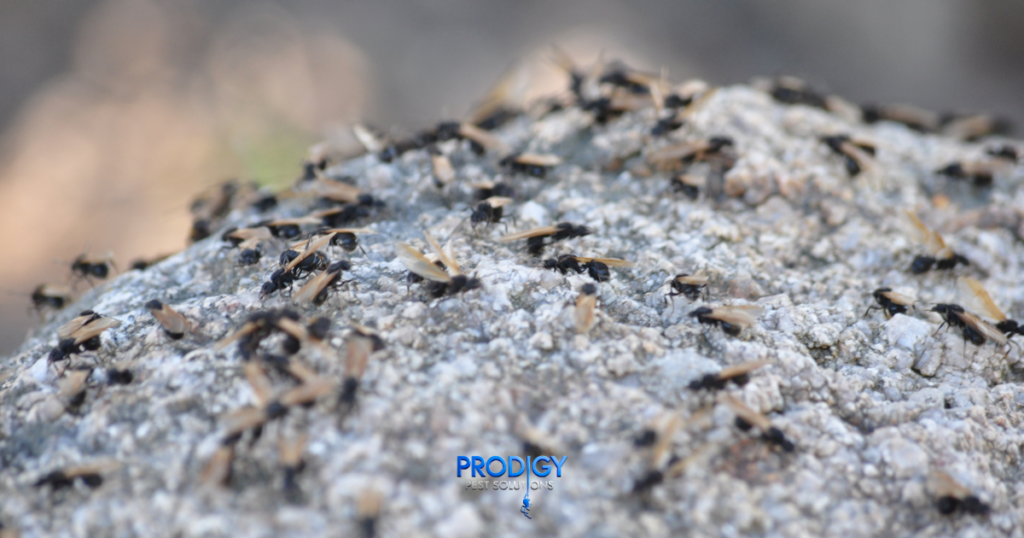
One warm, humid afternoon a swarm of winged insects appears around a window or light — and your first thought is probably “termites.” Often, though, they’re flying ants, a normal part of the ant life cycle that shows up across Florida in the warmer months. They’re usually more nuisance than threat, but they can also signal a carpenter ant nest in your home, or be mistaken for the termite swarmers you really don’t want to ignore. Here’s how to identify them and what to do.
Quick Answer: What Are Flying Ants?
Flying ants are winged reproductive ants — called alates — that leave the nest in swarms to mate and start new colonies. You can identify them by a pinched waist, bent (elbowed) antennae, and two pairs of wings with the front pair larger than the back. They’re mostly a seasonal nuisance, but because they can be confused with termite swarmers (which signal a serious problem) or indicate a carpenter ant nest, it’s worth identifying them correctly.
What Are Flying Ants?
Flying ants aren’t a separate species — they’re the reproductive members of an ordinary ant colony. When a colony matures, it produces winged males and females that leave together in a coordinated “nuptial flight” to mate and establish new colonies. These swarms are usually triggered by warm, humid weather, often on a still day after rain. After mating, the males die and the newly mated queens shed their wings and search for a place to nest — which is why you’ll sometimes find discarded wings around your home.
Flying Ants vs. Termite Swarmers: The Critical Difference
This is the comparison that matters most, because one is a nuisance and the other can mean structural damage. Check these features side by side before you panic — or relax.
| Feature | Flying Ant | Termite Swarmer |
|---|---|---|
| Waist | Narrow, sharply pinched | Broad and straight, no pinch |
| Antennae | Bent (elbowed) | Straight and bead-like |
| Wings | Front pair larger than back pair | Two pairs, all equal length |
| Color | Often black or reddish-brown | Usually pale to dark brown |
| What it means | Usually a seasonal nuisance | Possible active termite colony |
If the insects have a straight waist, straight antennae, and equal-length wings, treat it as a possible termite issue and read our guide on what termites look like — then get an inspection.
Why Am I Seeing Flying Ants?
A few things bring flying ants out, and where you see them tells you how concerned to be:
It’s swarming season. In Florida’s warm climate, ant colonies send out swarmers mostly in spring and summer, often in bursts after rain.
They’re drawn to light. Swarmers are attracted to windows, porch lights, and bright rooms, which is why they cluster at glass and fixtures.
There’s a colony nearby. A swarm outdoors usually just means a mature colony is in the area. A swarm emerging indoors is more telling — it often means a colony is nesting inside or under your home.
Moisture is present. Damp wood and humid areas attract nesting ants, especially carpenter ants, so recurring indoor swarms can point to a moisture problem.
Are Flying Ants Dangerous?
For the most part, flying ants are harmless. They don’t bite in any meaningful way during their flight, they don’t spread disease, and the swarm itself passes quickly. The concern is what they can represent. If the swarmers are carpenter ants, there’s a nest somewhere that’s excavating wood — not eating it like termites, but hollowing it out to build galleries, which can weaken structures over time. And if what you’re seeing turns out to be fire ant swarmers, the colony they came from can deliver painful stings. So while a flying ant itself is rarely a problem, identifying the species is worthwhile.
Common Flying Ants in Florida
Several Florida ants produce winged swarmers. The ones homeowners notice most are carpenter ants, large black or dark ants whose indoor swarms can indicate a nest in damp or damaged wood; fire ants, whose reproductive swarmers come from stinging colonies; and a range of smaller household ants that simply swarm and disperse. Identifying which you have points to the right fix — our guide to getting rid of ants covers the common Florida species in more detail.
Not Sure What’s Swarming?
Flying ants and termite swarmers are easy to confuse — and getting it wrong is costly. Prodigy Pest Solutions will identify the pest and check for nests. Reach out for a free inspection.
How to Get Rid of Flying Ants
Killing the visible swarmers is easy; solving the problem means dealing with the colony. Here’s the right order of operations:
1. Vacuum up the swarmers. For the ones already inside, a vacuum is faster and cleaner than sprays. Empty it outside afterward.
2. Don’t rely on sprays alone. Over-the-counter sprays kill the ants you see but leave the colony intact, so the swarms keep coming.
3. Find the source. Track where the swarmers are emerging. Indoors, follow them to wall voids, window frames, or damp wood; outdoors, look for nests near the foundation.
4. Use targeted baits for the colony. Ant baits are carried back to the nest and can eliminate the colony at its source — far more effective than surface spraying.
5. Fix the moisture. Repair leaks and reduce dampness, especially if carpenter ants are involved, to make your home less inviting.
How to Prevent Flying Ants
Preventing flying ants comes down to denying colonies a way in and a reason to stay:
Seal entry points. Caulk gaps around windows, doors, and utility lines where swarmers slip inside.
Control moisture. Fix leaks, improve drainage, and replace water-damaged wood that attracts nesting ants.
Trim vegetation. Keep branches, mulch, and shrubs from touching the house so colonies can’t bridge inside.
Manage exterior lighting. Swarmers flock to light; switching to less-attractive bulbs or moving fixtures away from doors helps.
Stop the Swarms at the Source
Recurring flying ants usually mean an established colony. Prodigy Pest Solutions finds and eliminates nests so the swarms stop for good. Contact us for your free inspection today.
When Flying Ants Mean a Bigger Problem
A one-time swarm outdoors is nothing to worry about. But repeated swarms emerging inside your home, large black ants appearing alongside sawdust-like shavings, or any doubt about whether you’re looking at ants or termite swarmers, all warrant a professional look. A technician can confirm the species, locate the nest, and treat the colony directly — turning a stressful swarm into a solved problem.
Frequently Asked Questions
| Question | Answer |
|---|---|
| Are flying ants the same as termites? | No. Flying ants are winged reproductive ants; termite swarmers are reproductive termites. They look similar but differ in three ways: ants have a pinched waist, bent antennae, and unequal wings, while termites have a straight waist, straight antennae, and equal-length wings. |
| Why do flying ants suddenly appear? | They emerge in coordinated ‘nuptial flights’ when a colony matures, usually on warm, humid days in spring and summer, often after rain. Large numbers appearing at once is normal for these mating swarms. |
| Are flying ants dangerous? | Flying ants themselves are essentially harmless — they don’t bite meaningfully or spread disease. The concern is what they indicate: carpenter ants can damage wood, and fire ant colonies can sting. |
| Do flying ants mean I have an infestation? | A swarm outdoors usually just means a colony is nearby. But flying ants emerging inside your home often mean a colony is nesting in or under the structure and should be inspected. |
| How do I get rid of flying ants for good? | Vacuum the visible swarmers, then treat the colony with targeted baits and address moisture and entry points. Killing only the swarmers you see won’t stop them; the nest has to be eliminated. |
| What months do flying ants swarm in Florida? | Most swarming happens in the warmer months, roughly spring through summer, though Florida’s mild climate means swarms can occur across a longer window than in cooler states. |
Serving Homes Across Florida
Prodigy Pest Solutions provides expert pest control throughout the region, including: