
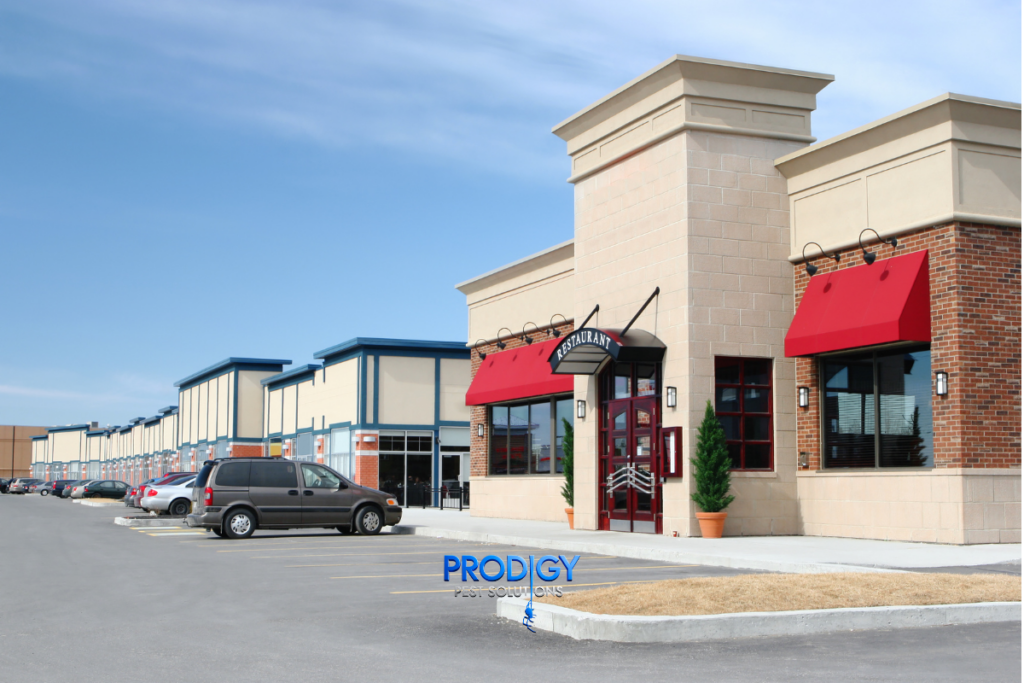
Tampa’s mix of century-old bungalows, sprawling port-side warehouses, and a booming restaurant and hospitality scene creates a uniquely challenging pest environment for local businesses. A single German cockroach sighting in a kitchen, or a rodent dropping in a stockroom, can trigger a failed health inspection, a canceled lease walkthrough, or a public review that’s hard to walk back. That’s why more property managers, restaurant owners, and facility directors are turning to commercial pest control in Tampa, FL from Prodigy Pest Solutions — a licensed, IPM-based program built to keep pests out and keep your business compliant.
Quick Answer: What Does Commercial Pest Control Cost and Include in Tampa, FL?
Prodigy Pest Solutions provides licensed commercial pest control in Tampa, FL for restaurants, retail centers, offices, warehouses, and HOAs, using Integrated Pest Management (IPM) rather than blanket spraying. A typical program includes an initial inspection, exclusion recommendations, discreet interior and exterior monitoring stations, scheduled treatments, and digital service documentation you can hand to a health inspector. Pricing depends on square footage, industry, and visit frequency — request a free commercial pest assessment for an exact quote.
Why Tampa Businesses Need a Dedicated Commercial Pest Control Partner
Tampa is one of the fastest-growing commercial markets on Florida’s Gulf Coast, and that growth brings pest pressure most standard, one-size-fits-all treatments were never designed to handle. Older buildings in Ybor City and Seminole Heights have gaps, cracks, and shared walls that give pests easy access between units. Newer construction near the Westshore business district and along the I-4 corridor still faces heavy landscaping irrigation and dumpster corrals that attract rodents and ants. Whatever your building’s age, a generic pest control visit isn’t enough to protect a commercial operation that has customers, employees, inventory, and a health department file on the line.
Tampa’s Climate Creates Year-Round Pest Pressure
Unlike businesses in northern states that get a true winter die-off, Tampa’s subtropical climate keeps most commercial pests active all year. Average lows rarely dip into the 30s, and humidity stays high enough that German cockroaches, ants, and rodents can breed continuously rather than going dormant. That means a commercial pest control plan built around occasional seasonal visits alone usually isn’t sufficient — Tampa businesses need monitoring and service scheduled to local pest pressure, with extra attention during Florida’s rainy season from June through September, when many pests move indoors seeking dry shelter.
Common Commercial Pests We Treat in the Tampa Bay Area
Prodigy’s Tampa technicians see the same handful of pests drive most commercial service calls and failed inspections:
Cockroaches
German cockroaches are the most common commercial infestation in Tampa kitchens, breeding quickly in warm equipment lines, behind refrigeration units, and inside cardboard packaging. American cockroaches (often called palmetto bugs) show up in drains, dumpster areas, and basements or crawl spaces. Both are treated as critical violations if seen live during a health inspection.
Rodents
Roof rats and Norway rats are common in Tampa warehouses, restaurants, and multi-family properties, especially near dumpsters, dense landscaping, and older roof lines with gaps. Rodent droppings alone are enough to fail a health inspection and can force product holds or recalls in food-handling environments.
Ants and Occasional Invaders
Ghost ants and Pharaoh ants are frequent problems in Tampa offices and food-service kitchens, drawn to sugar, grease, and moisture. Pharaoh ants are especially difficult to control with store-bought sprays, which can cause colonies to split (a process called budding) and make the infestation worse rather than better.
Stored Product Pests
Warehouses, grocery-adjacent retailers, and food-service operations in Tampa also deal with Indian meal moths and warehouse beetles that infest stored grain, pet food, and packaged goods — often arriving in incoming shipments rather than starting on-site.
Industries We Serve Across Tampa
Prodigy Pest Solutions builds a different service plan depending on your industry, because a healthcare facility’s risk profile looks nothing like a warehouse’s.
Restaurants & Food Service
Tampa’s restaurant and hospitality scene runs on health inspection scores and online reviews. Our restaurant pest control program is built around discreet, after-hours service, drain treatments, and documentation formatted for local health inspectors.
Retail, Offices & Warehouses
Retail centers, office parks, and distribution warehouses along Tampa’s I-4 and I-75 corridors need a different approach: exterior perimeter treatment, loading-dock exclusion, and stored-product-pest monitoring. See our guide to commercial pest control for warehouses, retail centers, and office parks for details.
Property Managers, HOAs & Multi-Family
Managing pest control across a multi-building portfolio or HOA community requires centralized scheduling and compliance reporting. Our property manager’s guide to commercial pest control compliance outlines how we support multi-property accounts.
Ready for a Pest-Free Tampa Property?
Get a customized commercial pest control plan for your Tampa restaurant, retail space, warehouse, or HOA — with no obligation.
Our IPM-Based Commercial Pest Control Process
Every Prodigy commercial account in Tampa follows our Integrated Pest Management (IPM) approach: a thorough initial inspection to identify entry points and conducive conditions, exclusion recommendations to physically seal gaps, strategically placed monitoring stations rather than blanket chemical application, and targeted treatment only where activity is confirmed. Every visit is logged digitally, giving you a running service history you can produce during a health inspection, insurance audit, or lease walkthrough.
DIY Pest Control vs. Professional Commercial Service
Store-bought sprays and bait stations can knock down a small ant trail, but they rarely solve a commercial-scale infestation — and they can create liability problems in food-handling or public-facing spaces. Here’s how the two approaches compare:
| Factor | DIY / Store-Bought Products | Prodigy Commercial Service |
|---|---|---|
| Licensing & liability | Not applied by a licensed technician; no liability coverage | Licensed, insured technicians with documented liability coverage |
| Health inspection documentation | None | Digital service records provided for every visit |
| Treatment scope | Surface-level, visible activity only | Full inspection, exclusion, and monitoring program |
| Product safety in food areas | Risk of contamination if misapplied | EPA-labeled products applied per food-safety protocols |
| Follow-up & monitoring | One-time, reactive | Scheduled visits with ongoing monitoring stations |
| Cost over time | Repeated purchases with inconsistent results | Predictable service plan with fewer repeat outbreaks |
Don’t Wait for a Failed Inspection
One pest sighting can undo years of reputation-building. Prodigy’s Tampa team responds fast and documents everything.
Staying Audit-Ready and Protecting Your Reputation
A pest problem rarely stays private for long — a single social media post or health inspection posting can do lasting damage to a Tampa business’s reputation. Our health-code and audit readiness checklist and guide to protecting your business’s reputation outline how proactive pest management keeps you ahead of inspectors, auditors, and online reviewers rather than reacting after the fact.
What Determines Commercial Pest Control Pricing in Tampa
Commercial pest control costs vary based on square footage, industry (restaurants and food storage typically require more frequent service than general office space), the number of locations, and whether exclusion work is needed. Our guide to commercial pest control costs in Florida breaks down typical pricing ranges — but the most accurate number comes from a free on-site assessment of your Tampa property.
Get a Custom Quote for Your Tampa Business
Every property is different. Let us build a pest control plan and price around your building, industry, and schedule.
Frequently Asked Questions
| Question | Answer |
|---|---|
| How quickly can Prodigy respond to a commercial pest issue in Tampa? | Most Tampa commercial accounts can be scheduled for an initial inspection within 24-48 hours, and active rodent or roach sightings ahead of an inspection are prioritized. |
| Will commercial pest control disrupt my business hours? | No. Prodigy schedules most commercial service after-hours or during low-traffic periods, using discreet monitoring stations instead of visible traps so customers and staff aren’t disturbed. |
| Do you provide documentation for health inspections? | Yes. Every service visit is logged digitally, and we provide printable service records formatted for local health inspectors and third-party auditors. |
| What industries does Prodigy serve in the Tampa Bay area? | We serve restaurants, retail centers, offices, warehouses and distribution centers, HOAs, multi-family properties, and hospitality businesses throughout Tampa and the surrounding Bay area. |
| Is Integrated Pest Management (IPM) required for Tampa businesses? | IPM isn’t legally required for most businesses, but it’s considered best practice by health departments and is often expected for schools, healthcare facilities, and some food-service certifications. Prodigy applies IPM principles across all commercial accounts. |
| How much does commercial pest control cost in Tampa? | Pricing depends on square footage, industry, and visit frequency. Plans range from modest monthly service for small offices to more comprehensive programs for restaurants and warehouses — request a free assessment for an exact quote. |
Commercial Pest Control Across Florida
Prodigy Pest Solutions provides commercial pest control throughout Florida, not just Tampa. Explore our commercial pest control services hub, or see our dedicated pages for Sarasota, Boca Raton, Port St. Lucie, and St. Augustine.